

Chapter 1: Challenges of Nation Building – Notes
● Introduction
□ India became independent on 15 August 1947.
□ Faced multiple challenges:
●Nation-building (Unity & Integrity)
●Establishing democracy
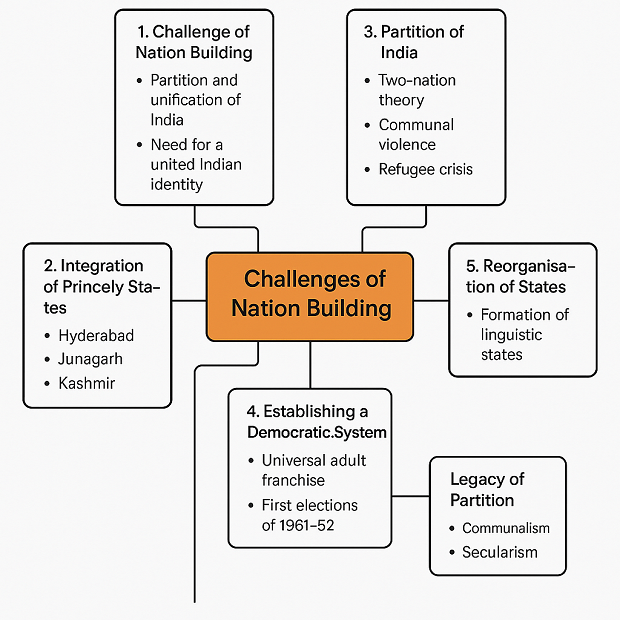
1. Challenge of Nation Building
●After partition, there was a need to unite:
□ Over 500 princely states
□ Diverse religions, languages, and cultures
●Needed a strong, united, and secular Indian identity.
2. Integration of Princely States
● Sardar Vallabhbhai Patel, India’s first Home Minister, played a key role
● 565 princely states were persuaded to join Indian Union.
Notable Challenges:
○ Kashmir: Hindu king, Muslim majority; joined India after Pakistani invasion → special status under Article 370 (later abrogated in 2019).
○ Hyderabad: Ruled by Nizam; wanted to remain independent → merged through police action (1948).
○ Junagarh: Nawab wanted to join Pakistan despite Hindu majority → annexed by India.
3. Partition of India
○ Based on two-nation theory by Muslim League.
○ Led to creation of India and Pakistan.
○ Caused massive communal violence, refugee crisis, and displacement (~10 million people).
○ Mahatma Gandhi was in Kolkata during Independence, promoting peace.
4. Establishing a Democratic System
○ India chose universal adult franchise (every adult can vote), which was called “biggest gamble in history”.
○ First General Elections held in 1951–52.
○ Election Commission led by Sukumar Sen.
5. Reorganisation of States (on linguistic basis)
- Many demands to create states based on language.
- Initially denied by Nehru government.
- After Potti Sriramulu’s death (fast for Andhra), statehood was granted.
- States Reorganisation Commission (1953) was formed.
- Led to the States Reorganisation Act (1956).
6. Legacy of Partition
- Birth of communalism and religious politics.
- Fear of further separatism.
- India adopted secularism: equal respect for all religions.
7. Role of Leaders
- Jawaharlal Nehru: Focused on democracy, planning, secularism.
- Sardar Patel: Integrated princely states.
- Dr. B.R. Ambedkar: Chairman of the Drafting Committee of Constitution.
- Mahatma Gandhi: Promoted peace and harmony.
Multiple choice questions with options and answers
1. Which one of the following from the North-East had become a state before 1972?
a) Meghalaya
b) Nagaland
c) Tripura
d) Manipur
Answer: b) Nagaland
2. Sardar Vallabhbhai Patel faced key challenges of integration in which of the following states?
a) Hyderabad, Sikandrabad, Jammu
b) Jammu, Junagarh, Kashmir
c) Hyderabad, Moradabad, Junagarh
d) Hyderabad, Junagarh, Kashmir
Answer: d) Hyderabad, Junagarh, Kashmir
3. Which among the following states was first created on the linguistic basis in India?
a) Uttar Pradesh
b) West Bengal
c) Punjab
d) Andhra Pradesh
Answer: d) Andhra Pradesh
4. Which of the following statement is not false?
a) All of these
b) Mahatma Gandhi wanted to become the Prime Minister of India.
c) Mohammed Ali Jinnah wanted to remain with Indian Union.
d) The year 1947 was a year of unprecedented violence and the year of displacement.
Answer: d) The year 1947 was a year of unprecedented violence and the year of displacement.
5. On the 15th of August 1947, Mahatma Gandhi did not participate in any of the Independence day celebrations. He was in ________.
a) Kolkata
b) Delhi
c) Sabarmati
d) Naokhali
Answer: a) Kolkata
6. The States Reorganisation Commission was appointed in 1953 to ________.
a) merge the Princely States with India
b) reorganise only the provinces under the British control
c) recommend the formation of Union Territories
d) redraw the boundaries of States
Answer: d) redraw the boundaries of States
7. When was the State Reorganisation Commission appointed by the Central Government?
a) In 1948
b) In 1956
c) In 1972
d) In 1953
Answer: d) In 1953
8. The communal zones exclude:
a) Jammu & Kashmir
b) Lahore
c) Amritsar
d) Kolkata
Answer: a) Jammu & Kashmir
9. When was States Reorganisation Commission formed?
a) 1963
b) 1964
c) 1953
d) 1950
Answer: c) 1953
10. Which group among the following options represents the three Princely States that resisted their merger with India?
a) Hyderabad, Bhopal, Jammu and Kashmir
b) Gwalior, Travancore, Bhopal
c) Junagarh, Hyderabad, Travancore
d) Junagarh, Gwalior, Mysore
Answer: c) Junagarh, Hyderabad, Travancore
11. How many kinds of challenges that Independent India faced?
a) 2
b) 1
c) 5
d) 3
Answer: d) 3
12. Which one of the following leaders played an important role in the integration of princely states with India?
a) Sardar Vallabhbhai Patel
b) B.R. Ambedkar
c) C. Rajagopalachari
d) Jawaharlal Nehru
Answer: a) Sardar Vallabhbhai Patel
13. When was Gujarat state created?
a) 1980
b) 1960
c) 1950
d) 1970
Answer: b) 1960
14. Reorganisation of the North-East was almost completed in
a) 1972
b) 1982
c) 1962
d) 1992
Answer: a) 1972
15. The rulers of most of the Princely States had agreed to become a part of the Union of India ________.
a) before 15th of August, 1947
b) on 26th of January, 1950
c) after 26th of January, 1950
d) on 15th of August, 1947
Answer: a) before 15th of August, 1947
16. What is the name of the leader who is also known as Frontier Gandhi in the Independence movement?
a) Morarji Desai
b) Loknayak JP Narayan
c) Khan Abdul Gaffar Khan
d) Sheikh Abdullah
Answer: c) Khan Abdul Gaffar Khan
17. Which state was not created in 2000?
a) Chhatisgarh
b) Jharkhand
c) Bihar
d) Uttaranchal
Answer: c) Bihar
18. Khan Abdul Gaffar Khan, the undisputed leader of the North Western Frontier Province was known as:
a) Patriot of Pakistan
b) Frontier Gandhi
c) Staunch Muslim
d) Father of Pakistan
Answer: b) Frontier Gandhi
19. How many princely states existed at the time of independence of India?
a) 560
b) 565
c) 562
d) 563
Answer: b) 565
20. For the first time the Communist Party came to power through democratic elections in which state of India?
a) W. Bengal
b) Tripura
c) Kerala
d) Manipur
Answer: c) Kerala
21. The first three Lok Sabha elections of 1952, 1957, and 1962 were dominated by the Congress Party under the leadership of:
a) Indira Gandhi
b) Shyama Prasad Mukherjee
c) Mahatma Gandhi
d) Jawaharlal Nehru
Answer: d) Jawaharlal Nehru
22. Who among the following leaders was not a minister in Jawaharlal Nehru’s Cabinet formed in 1948 after independence?
a) Sardar Vallabhbhai Patel
b) Maulana Abul Kalam Azad
c) Mahatma Gandhi
d) B.R. Ambedkar
Answer: c) Mahatma Gandhi
23. Identify the political party which lays emphasis on the idea of one country, one culture and one nation.
a) Communist Party of India
b) Bharatiya Jana Sangh
c) Swatantra Party
d) Indian National Congress
Answer: b) Bharatiya Jana Sangh
24. The socialists advocated the ideology of:
a) Hindutva
b) Socialism
c) Democratic Socialism
d) Communalism
Answer: c) Democratic Socialism
25. Which political party was at the second place in winning the Lok Sabha seats in the first general elections of India?
a) Communist Party of India
b) Socialist Party
c) Swatantra Party
d) Bhartiya Jana Sangh
Answer: a) Communist Party of India
26. The First General Elections in India were held in the year:
a) 1951
b) 1952
c) 1954
d) 1953
Answer: b) 1952
27. Which of the following states got non-Congress ruling in 1st legislative elections?
a) Uttar Pradesh
b) Kerala
c) Madhya Pradesh
d) Bihar
Answer: b) Kerala
28. When did Hindu Mahasabha come into existence?
a) 1924
b) 1914
c) 1885
d) 1915
Answer: b) 1914
29. Institutional Revolutionary Party exercised power in:
a) Finland
b) Mexico
c) Cairo
d) Brazil
Answer: b) Mexico
30. Which one of the following is a state where Congress did not win even after a huge victory in the first general elections?
a) Bihar
b) Madhya Pradesh
c) Maharashtra
d) Orissa
Answer: d) Orissa
31. How many seats did Indian Congress win in general election 1952?
a) 365
b) 384
c) 364
d) 360
Answer: c) 364
32. What was called “the biggest gamble in history”?
a) The era of Congress dominance
b) Universal adult franchise
c) The first general elections of 1952
d) Emergency of 1975
Answer: b) Universal adult franchise
33. Who was the Education Minister in the first Union Cabinet of free India?
a) Khan Abdul Ghaffar Khan
b) K. Kamaraj
c) Maulana Abul Kalam Azad
d) Karpoori Thakur
Answer: c) Maulana Abul Kalam Azad
34. Fabian socialism is also called _________.
a) Liberalism
b) Marxism
c) Democratic Socialism
d) Capitalism
Answer: c) Democratic Socialism
35. Which political party of India worked mainly from within the fold of the Indian National Congress from 1935 to 1941 before parting ways?
a) Bharatiya Jana Sangh
b) Swatantra Party
c) Communist Party of India
d) Socialist Party
Answer: d) Socialist Party
36. Name the founder President of Congress Socialist Party.
a) Sukumar Sen
b) Shayama Prasad Mukherjee
c) Acharya Narendra Dev
d) K.M. Munshi
Answer: c) Acharya Narendra Dev
Assertion(A) Reason(R)
a) Both A and R are true and R is the correct explanation of A.
b) Both A and R are true but R is not the correct explanation of A.
c) A is true but R is false.
d) A is false but R is true.
37. Assertion (A): There were no single belt of uniform Muslim majority areas in British India. There were two areas of concentration one in the west and in the east.
Reason (R): Not all Muslim majority areas wanted to join with Pakistan.
Answer: a) Both A and R are true and R is the correct explanation of A.
38. Assertion (A): The partition of India was the outcome of the two-nation theory.
Reason (R): Punjab and Bengal were the two provinces divided on the basis of religion.
Answer: a) Both A and R are true and R is the correct explanation of A.
39. Assertion (A): The ruler of Travancore decided to remain independent and Nizam of Hyderabad made a similar announcement the next day.
Reason (R): With the end of British rule in India, the paramountcy of the British crown over princely rulers also came to an end.
Answer: a) Both A and R are true and R is the correct explanation of A.
40. Assertion (A): Movement of the people of Hyderabad State against the Nizam’s rule had gathered force and momentum.
Reason (R): Peasantry and women joined hands against the oppressive rule of the Nizam.
Answer: a) Both A and R are true and R is the correct explanation of A.


