

Learn all about Communication Skills with this concise summary and notes. Understand types of communication, the communication cycle, barriers, and methods for effective communication — ideal for students, competitive exams, and skill development courses
1. Meaning of Communication
Communication is the process of exchanging thoughts, ideas, facts, opinions, or emotions between two or more people.
2. Types of Communication
| Type | Description | Examples |
|---|---|---|
| Verbal | Spoken or oral communication | Face-to-face talk, phone call |
| Non-verbal | Without words (gestures, body language, facial expressions) | Eye contact, posture, sign language |
| Written | Using written symbols/words | Emails, reports, letters |
| Visual | Use of images/charts/graphics | Graphs, maps, posters, signs |
3. Barriers to Communication
| Barrier Type | Description | Example |
|---|---|---|
| Physical | Environmental factors | Noise, broken phone line |
| Semantic | Language or symbol confusion | Jargon, unclear language |
| Psychological | Mental/emotional interference | Stress, fear, bias |
| Technical | Device or technology failure | Internet issue, system crash |
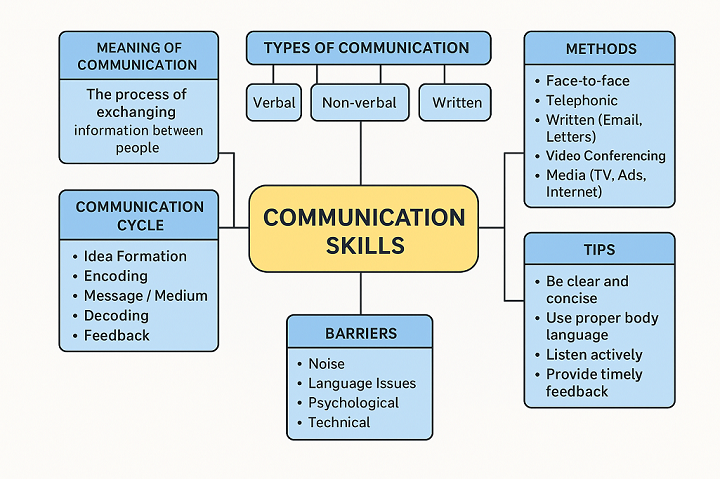
Communication Skills Multiple Choice Questions
- Which of the following is a method of communication?
a) Listening
b) Reading
c) Speaking
d) All of the above
Answer: d) All of the above - Which method of communication uses body language and facial expressions?
a) Verbal communication
b) Written communication
c) Non-verbal communication
d) Digital communication
Answer: c) Non-verbal communication - Email is an example of which type of communication?
a) Oral
b) Written
c) Non-verbal
d) Visual
Answer: b) Written - Which of the following is NOT a form of verbal communication?
a) Telephonic conversation
b) Video conferencing
c) Text messaging
d) Face-to-face talking
Answer: c) Text messaging - Which communication is fastest in terms of delivering messages?
a) Postal letters
b) Face-to-face communication
c) Newspaper
d) Email
Answer: b) Face-to-face communication - Gestures and postures are a part of:
a) Written communication
b) Non-verbal communication
c) Verbal communication
d) None of the above
Answer: b) Non-verbal communication - Which method is best for storing data permanently?
a) Verbal communication
b) Written communication
c) Non-verbal communication
d) Face-to-face communication
Answer: b) Written communication - A video call is an example of:
a) Verbal only
b) Non-verbal only
c) Both verbal and non-verbal
d) Written communication
Answer: c) Both verbal and non-verbal - Sign language is used in:
a) Written communication
b) Verbal communication
c) Non-verbal communication
d) None of the above
Answer: c) Non-verbal communication - What is the main disadvantage of written communication?
a) Time-consuming
b) Immediate feedback
c) Interactive
d) Easy to remember
Answer: a) Time-consuming - Which of the following is not a non-verbal cue?
a) Eye contact
b) Posture
c) Tone of voice
d) Handshake
Answer: c) Tone of voice - Which method of communication is best for clarifying doubts immediately?
a) Written
b) Verbal
c) Non-verbal
d) Visual
Answer: b) Verbal - In formal communication, which method is mostly used?
a) Verbal
b) Non-verbal
c) Written
d) Gestures
Answer: c) Written - What type of communication does an advertisement on TV represent?
a) Verbal only
b) Visual and non-verbal
c) Written
d) Verbal and non-verbal
Answer: d) Verbal and non-verbal - Using emojis in a message is a part of:
a) Verbal communication
b) Written communication
c) Non-verbal communication
d) Formal communication
Answer: c) Non-verbal communication - Which communication method allows interaction between sender and receiver at the same time?
a) One-way
b) Two-way
c) Passive
d) Delayed
Answer: b) Two-way - Which form of communication is most common in business?
a) Non-verbal
b) Verbal
c) Written
d) Oral
Answer: c) Written - Communication using charts and graphs is:
a) Verbal
b) Visual
c) Written
d) Oral
Answer: b) Visual - Which of the following is NOT a method of verbal communication?
a) Debate
b) Chatting face-to-face
c) Reading a book
d) Speech
Answer: c) Reading a book - Which one is a limitation of non-verbal communication?
a) Easy to understand
b) No language barrier
c) Not universally interpreted
d) Fast feedback
Answer: c) Not universally interpreted - What is the first step in the communication cycle?
a) Feedback
b) Decoding
c) Encoding
d) Idea formation
Answer: d) Idea formation - In communication cycle, the process of converting thoughts into words is called:
a) Decoding
b) Receiving
c) Encoding
d) Feedback
Answer: c) Encoding - Who initiates the communication process?
a) Receiver
b) Channel
c) Sender
d) Medium
Answer: c) Sender - What is the role of a medium in communication?
a) Create message
b) Interpret message
c) Deliver message
d) Provide feedback
Answer: c) Deliver message - Decoding is done by:
a) Sender
b) Channel
c) Medium
d) Receiver
Answer: d) Receiver - Which of the following is the last step in communication cycle?
a) Encoding
b) Feedback
c) Message
d) Decoding
Answer: b) Feedback - Which of these is an example of a communication channel?
a) Telephone
b) Book
c) Email
d) All of the above
Answer: d) All of the above - What is ‘Feedback’ in communication?
a) Receiving the message
b) Creating the message
c) Response to the message
d) Ignoring the message
Answer: c) Response to the message - If the receiver fails to understand the message, communication is:
a) Successful
b) Interrupted
c) Incomplete
d) Failed
Answer: d) Failed - Noise in communication refers to:
a) Background sound
b) Distraction or interruption
c) Poor signal
d) All of the above
Answer: d) All of the above - Which of the following ensures the message is understood correctly?
a) Encoding
b) Feedback
c) Channel
d) Noise
Answer: b) Feedback - Which of the following can act as a barrier in communication?
a) Clarity
b) Common language
c) Noise
d) Understanding
Answer: c) Noise - What is the role of a sender in the communication cycle?
a) Interpret the message
b) Provide feedback
c) Initiate and send the message
d) Act as a medium
Answer: c) Initiate and send the message - A broken telephone line represents which type of barrier?
a) Semantic
b) Psychological
c) Physical
d) Technical
Answer: c) Physical - Feedback helps in:
a) Closing the communication loop
b) Starting the communication
c) Encoding the message
d) Interrupting the process
Answer: a) Closing the communication loop - What is the message in the communication cycle?
a) The process
b) The idea or information
c) The feedback
d) The medium
Answer: b) The idea or information - Effective communication occurs when:
a) The sender uses long sentences
b) Receiver gives no feedback
c) The message is clearly understood
d) Only sender speaks
Answer: c) The message is clearly understood - When the sender encodes and the receiver decodes, it leads to:
a) Confusion
b) Completion of communication cycle
c) Start of the feedback
d) None of the above
Answer: b) Completion of communication cycle - Communication is successful only when:
a) It is written
b) Both parties are involved
c) There is no feedback
d) Only verbal methods are used
Answer: b) Both parties are involved - The process of communication cycle is:
a) Linear
b) Circular
c) One-way
d) Static
Answer: b) Circular
